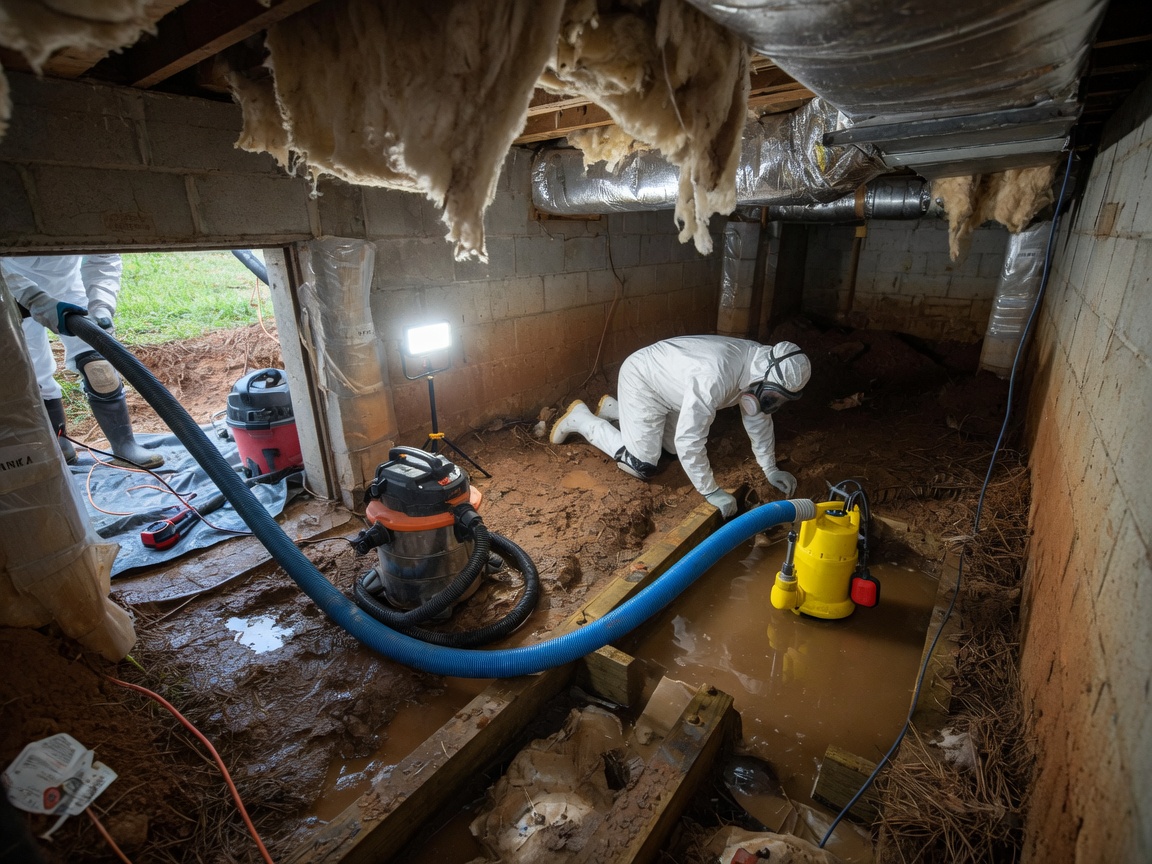
Wake County builds over vented crawl spaces far more than over basements. A supply line failure, a groundwater push through Piedmont clay, or a downspout that dumps against the foundation leaves water under the house where nobody walks. The first signs upstairs are often a musty smell, soft flooring, or insulation hanging from the joists.
We pull the standing water, bag soaked batts when they have held water, and meter the joists and sill. Emergency water extraction from the living space is a different map if the water also reached finished floors. Under the house, the job is access, pumping, and getting air and dehumidification into a low, dirty bay.
After free water is gone, structural drying with crawl-space dehumidifiers is what stops the mold engine. A vapor barrier on bare soil blocks ground moisture. Encapsulation and a sized dehumidifier are the next step when the vents are still feeding humid outdoor air into a wet crawl. We will say which level you need rather than selling the largest package by default.
If growth is already on the paper face of the insulation or on the joists, that becomes crawl space mold remediation after the moisture source is controlled. North Carolina does not license mold remediators. We follow industry containment practice. What to do when a pipe bursts in the crawl is the homeowner checklist we give on the phone.
Technician insight
A vented crawl can read dry at the hatch and still hold a pool against the far foundation wall. We crawl the perimeter with a light before we call the pump-out done.
Crawl Space Water Removal Services We Offer
✓Standing Water Pump-Out
Free water removed from the crawl floor and low spots against the foundation.
✓Wet Insulation Pull
Batts that held water bagged and removed so wood can dry.
✓Post-Extraction Moisture Map
Pin readings on framing so drying targets the wet bays, not the whole footprint.
Pricing
Priced by affected area, water category, and drying days. You get the number in writing before equipment is set.